



Air or sea for fresh produce? Compare cost per sellable kilogram
By VegoFresh Editorial Team · Published
A freight quote is only one input. Compare the full landed cost against kilograms meeting the buyer's arrival grade and the time left to sell them.
Evidence and route conditions are named in the article. Results for one crop or setting should be checked against the buyer’s own arrival standard.
Should a fresh-produce buyer move a crop from air to sea? Compare the cost of each kilogram that passes the agreed arrival grade, with enough time left to sell it. Freight price per booked kilogram is only one input. For fragile produce, a lower transport quote can be outweighed by more rejected product or too little selling time.
IATA’s perishable-cargo guidance describes how packaging, handling, storage conditions and delays matter even on an air route. Sea freight adds a different time and handoff profile. Neither mode can be judged from its headline transit time or rate without the crop’s actual response to the complete journey.
Industry discussion (anecdotal): A flower cold-chain supplier discusses continuous cooling and the cost pressure behind flower sea-route trials. This is a trade perspective, not a verified freight rate or shipment outcome. Use it to ask about handoff costs and accepted flowers at destination before comparing routes. Source: Xiaohongshu note by CHRYSAL可利鲜 (reviewed 10 October 2026).
Build two comparable route scenarios
Use the same cultivar, harvest maturity, sourcing season, pack size, buyer grade and destination for the air and sea scenarios. Then map each route from farm to the specified acceptance point. Include collection, pre-cooling, storage, packing, inland transfer, terminal or airport dwell, transport, border clearance, unloading and final delivery. Estimate a range where departure or clearance timing is uncertain; a single “best case” sailing schedule is not a commercial plan.
The FAO’s cold-chain guidance highlights continuity from harvest through storage and transport. A route model should therefore include the cost of keeping that continuity, not only the carrier’s invoice. The carrier guidance from Hapag-Lloyd also says a reefer container is designed mainly to maintain pre-cooled cargo temperature. If the sea scenario assumes warm fruit will be cooled after loading, revise the process and quote before comparing modes.
Which costs belong in the numerator?
| Cost group | Questions for both scenarios |
|---|---|
| Crop and preparation | What do procurement, sorting, pack material, pre-cooling and preservation treatment cost for the shipped quantity? |
| Movement and handoffs | What are inland freight, handling, carrier charges, insurance, port or airport charges, customs and final delivery? |
| Quality loss | How much is rejected, downgraded, discarded or returned, and who bears each expense under the contract? |
| Time and inventory | Does the buyer need extra safety stock, finance longer inventory, or miss a short sales window? |
Use the actual commercial terms. Avoid counting the same loss twice: if the purchase cost of every shipped kilogram is already in the numerator, do not add it again as a “spoilage cost.” Add only incremental disposal, rework, claim or replacement expense that is genuinely outside the original purchase and logistics total. A landed-cost model is useful only when its assumptions can be audited.
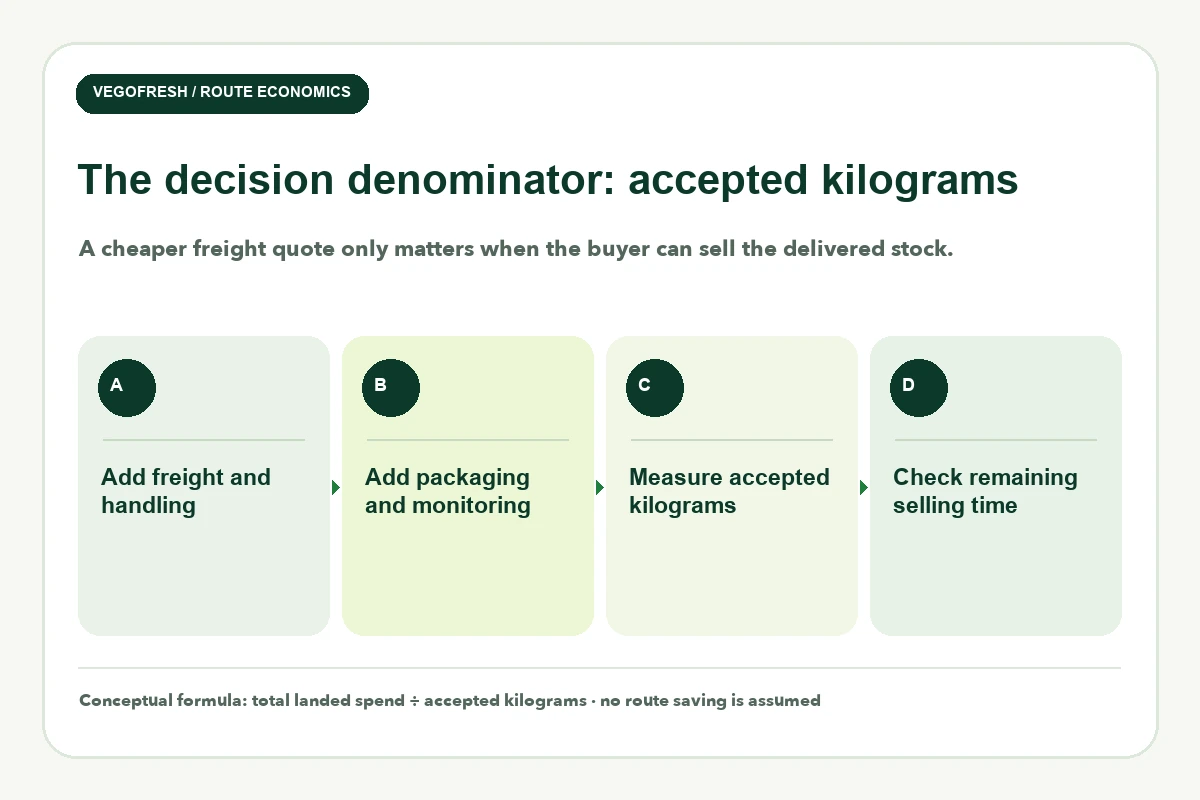
How do you estimate accepted kilograms before a full rollout?
First agree on a repeatable inspection protocol. Define which cartons are sampled, when and where they are opened, the defect categories, tolerances, accepted weight and the reporting form. Then run the proposed crop and pack through a realistic trial. Record product temperature at key handoffs, in-transit conditions, rejected weight and post-arrival quality. For US produce transactions, the USDA’s PACA good-delivery material illustrates why contract terms and crop-specific defects matter; its FOB table is limited to particular US sales and short transit periods, so it should not be copied as a global sea-freight standard.
Keep a separate line for remaining selling time. Two routes might deliver the same accepted kilograms, yet one may leave the buyer too few days for wholesale and retail distribution. That outcome is commercially different even before discounting or waste. Our shelf-life evidence guide explains why storage days cannot be substituted for post-arrival saleable days.
What would justify a sea trial?
A sea trial is reasonable when the crop’s condition data, a door-to-door schedule, a viable pre-cooling and monitoring plan, and the buyer’s acceptance standard can all be specified. It should compare the proposed pack against the current air route, with the same grade and comparable harvest lots. If the data do not support the buyer’s quality window, keep air or redesign the pack and handling steps.
We do not apply a fixed percentage saving across leafy greens, strawberries and cut flowers. Each has different quality endpoints. Review the VegoFresh route-assessment process, then send us your crop, destination and buyer grade to define a meaningful air-versus-sea comparison.
Turn the article into a test plan.
Tell us the crop, origin, destination and arrival standard. We can identify which records are relevant and what still needs validation.