



Can cut flowers travel by sea? Design a buyer-ready trial
By VegoFresh Editorial Team · Published
Storage time, transit time and vase life answer different questions. Set an arrival grade and post-arrival test before moving flowers to sea.
Evidence and route conditions are named in the article. Results for one crop or setting should be checked against the buyer’s own arrival standard.
Short answer: A cut flower is a candidate for an ocean route only when a trial shows that the named cultivar arrives at an agreed grade and still offers the buyer enough vase life. Days in a cold room, days in transit, and days in a customer’s vase are three different measures. A long storage result alone cannot establish an acceptable sea shipment.

This distinction matters for roses and carnations. UC Davis advises storage around 0–1°C for both, yet its conventional guidance differs sharply by flower and harvest stage. It describes up to about two weeks of dry storage for roses near the freezing point, while open carnations and bud-cut carnations have different storage windows. These are commodity guidance under stated conditions, not a promise that a commercial shipment will have the same number of saleable days. See the UC Davis rose fact sheet and carnation fact sheet.
Industry discussion (anecdotal): A commercial flower-export guide discusses pre-cooling, protective packing, transfer exposure and arrival checks. Its quoted rates and loss figures are not independent trial results. Use those topics to design a named-cultivar voyage and vase-life test. Source: Xiaohongshu note by 天锐国际冷链-栋哥 (reviewed 10 October 2026).
Start with the customer’s selling window
Ask the importer how the flowers will be sold. A wholesale buyer preparing for an event may need a tight opening stage and a precise delivery date. A retailer may need flowers that can survive an additional store and consumer display period. The useful question is not “Can this rose last 30 days?” It is “What proportion of this cultivar will meet the agreed grade on arrival, and how will it perform during the buyer’s intended display period?”
Put that question in a written acceptance plan. Define cultivar, stem length and strength, bud stage, visible bruising, petal discoloration, disease, and minimum vase-life performance after unpacking. Set who will inspect, when they will inspect, how stems will be sampled, and which photographs and temperature records will accompany the result. A route trial without a shared endpoint produces an impressive day count but a weak buying decision.
Build the trial around the whole journey
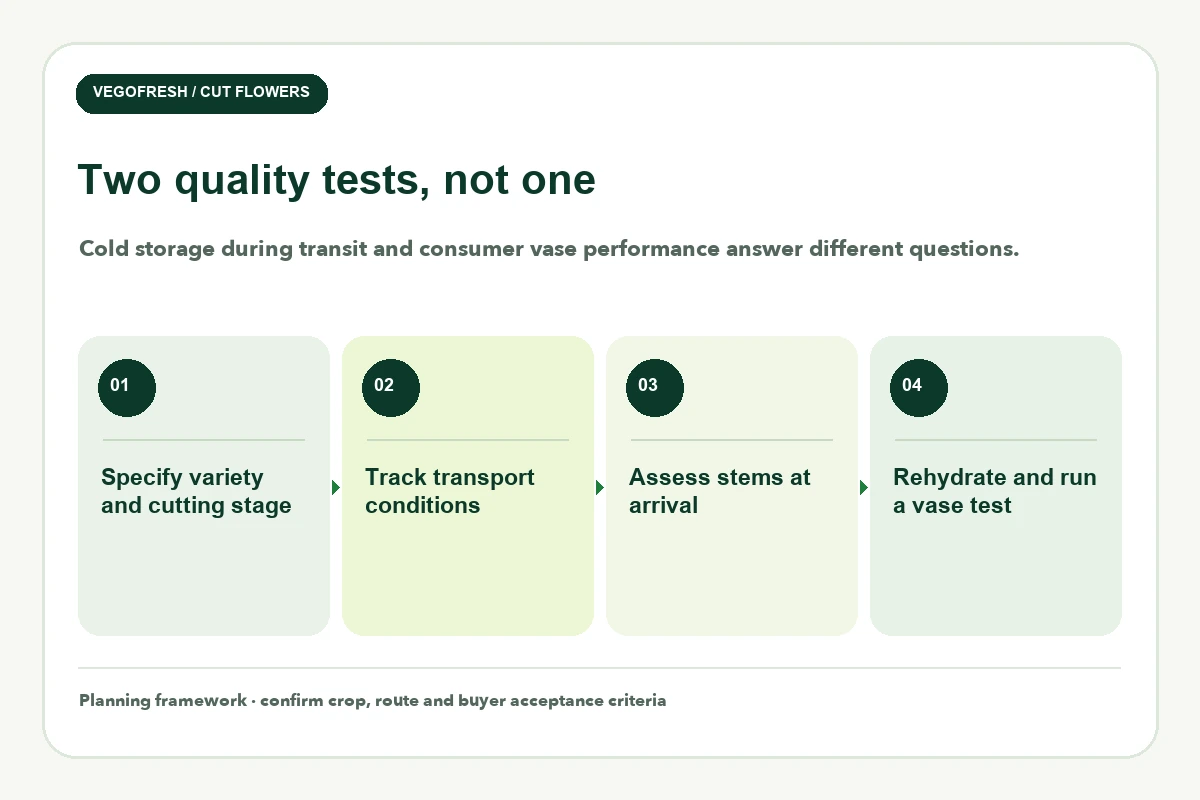
The trial should follow the flower from harvest, not begin when the container door closes. Record harvest maturity and time to pre-cooling. Specify bunching, sleeve or box design, dry or wet handling, pallet ventilation, and any authorised postharvest treatment. Then map inland movement, port dwell, vessel transit, clearance, unpacking, rehydration and delivery. FAO’s cold-chain guidance explains why temperature management is a connected process across handling stages rather than a single container setting.
Choose monitoring points that show both the environment and the product. A reefer air-temperature log is useful, but it does not tell the whole story of how warm the flower boxes were at loading or how they performed after a delay. Document the condition of representative boxes at handover and arrival. If the route crosses several operators, name who records the handoff.
Score arrival quality and vase life separately
| Question | Record at arrival | Record after unpacking |
|---|---|---|
| Appearance | Bud opening stage, bruising, bent neck, petal damage, disease signs | Opening consistency and visible deterioration during display |
| Handling | Box condition, condensation, product temperature, treatment record | Rehydration method and display temperature |
| Commercial result | Stems accepted against the agreed grade | Days meeting the buyer’s display standard |
Do not collapse these columns into one “freshness” figure. A stem may appear attractive when the box is opened but fail to open normally in a vase. The reverse is possible too: an arrival inspection may reject defects that a general storage study never measured. Record both outcomes on the same sampled stems when practical, so the buyer can connect arrival grade to actual selling performance.
Why one flower’s result cannot validate another
UC Davis notes that some rose cultivars are sensitive to ethylene and that petal condensation can encourage Botrytis. Its carnation guidance discusses different bud and open-flower handling, with ethylene exposure capable of premature petal wilting. Those risks suggest trial questions; they are not a universal prescription for lilies or every rose and carnation cultivar. A new cultivar, season, packing format or route should be checked against the original test conditions before the result is reused.
This is an export-trial framework based on publicly linked postharvest guidance. It does not report a VegoFresh commercial flower arrival result or verify a 30-day flower shipment. For how to evaluate such claims, read our shelf-life evidence guide.
A practical go/no-go checklist
- Agree on the exact species, cultivar, harvest stage and buying grade.
- Record harvest, cooling, packing and all planned handoffs.
- Set the trial route, its realistic delay allowance and monitoring method.
- Inspect a documented sample immediately on arrival.
- Run a vase-life comparison under the buyer’s normal display conditions.
- Compare the sea trial with the buyer’s existing air route on accepted stems, selling time and total landed cost.
If any of those steps cannot be measured, begin with a smaller storage or simulated-route test. If the results are strong, repeat the route trial before making a standing purchasing commitment. Our fresh-export solutions page explains how a crop-specific route assessment works. To assess a flower programme, send us the cultivar, destination and target delivery window.
Turn the article into a test plan.
Tell us the crop, origin, destination and arrival standard. We can identify which records are relevant and what still needs validation.