


Fresh-produce arrival inspection: a buyer’s evidence checklist
By VegoFresh Editorial Team · Published
A reefer set point is not a product grade. Capture thermal history, representative defects and accepted kilograms at the buyer's receiving point.
Evidence and route conditions are named in the article. Results for one crop or setting should be checked against the buyer’s own arrival standard.
Short answer: Inspect fresh produce against a written buyer specification as soon as it arrives, then record product temperature, packaging condition, representative defects, accepted quantity and remaining selling performance. A reefer set point or a supplier’s storage-day figure is not an arrival-quality result. Agree on sampling and dispute procedures before dispatch.

Exporters often show the container’s temperature screen or a photo of attractive boxes. Neither tells the importer how many cartons meet the purchase standard. The FAO cooling and cold-storage module describes temperature management as part of the horticultural chain and notes that cold-chain breaks and product temperature matter. A logger records the environment at its location; sampled product temperature tells a different story. Both belong in the receiving file.
Industry discussion (anecdotal): A cold-chain delivery note recommends checking more than carton count at receipt. It concerns general food delivery, not an export grading standard. As a practical prompt, record seal, handoff time, carton condition, product temperature and exception photos against crop-specific contract criteria. Source: Xiaohongshu note by 河南飞洁冷链物流 (reviewed 10 October 2026).
Write the acceptance rule before shipment
Define the exact commodity, cultivar, size or weight band, maturity, permitted visual defects, pack count, minimum usable weight and planned selling window. Include who may inspect, the time after delivery allowed for an inspection, the sample design, and how an independent inspection will be requested if the parties disagree. The criteria should match the buyer’s real market. A supermarket punnet, a food-service crate and a cut-flower bundle should not share a vague “fresh on arrival” rule.
For US transactions governed by the Perishable Agricultural Commodities Act, USDA AMS good-delivery guidance explains how defects can be assessed against specific contractual and commodity rules. Its FOB good-delivery table is framed around short transit and US legal context; it is not a universal tolerance for a multiweek export voyage. Use it as an example of why product, sale terms and defect definitions must be stated precisely, then use the rules that actually govern the contract.
Capture the first evidence before the cargo changes
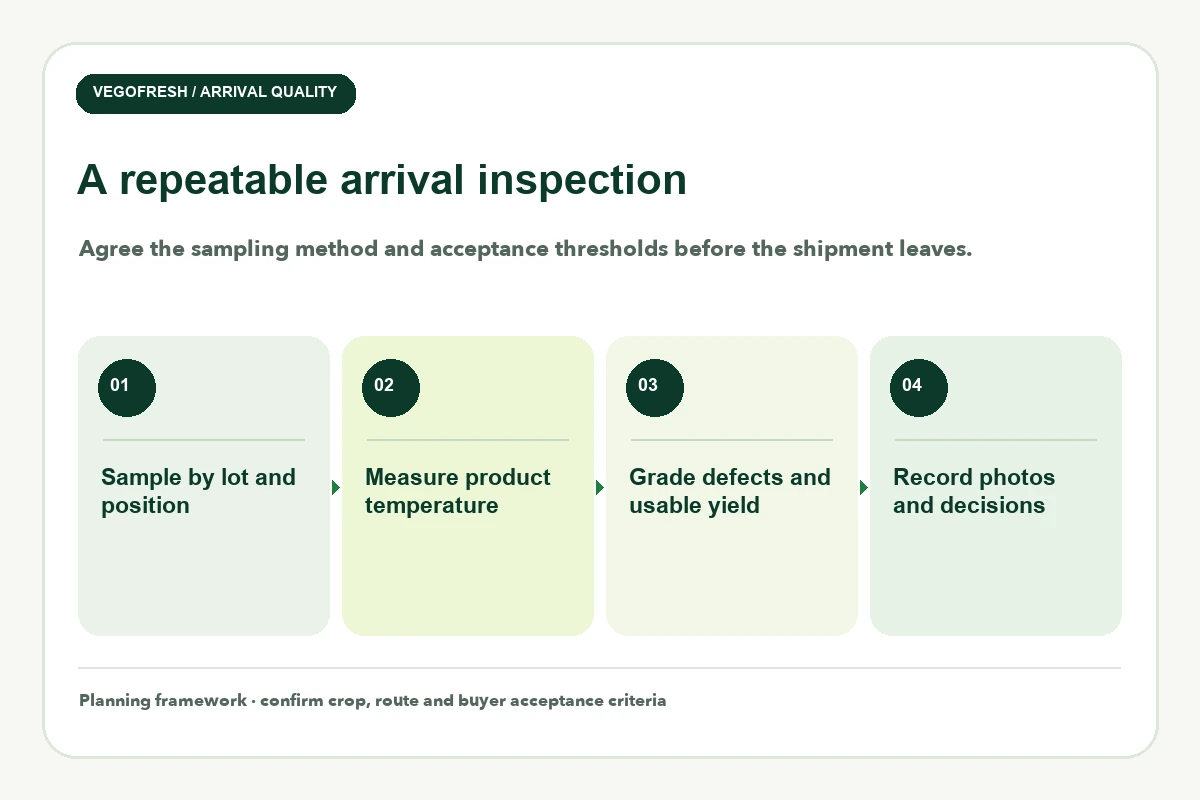
At the receiving point, note arrival date and time, vehicle or container ID, seal condition, door opening, ambient conditions and any visible water or damage. Photograph the outside and inside of selected cartons before reorganising the load. Download a time-temperature file if available and preserve the raw version. Measure product temperature using an agreed method at more than one position in the load; a single instrument reading at the door can miss variation deeper in the pallets.
Inspect a representative sample, not the best carton
Agree in advance how cartons will be selected across the load, including front, middle and rear positions or other relevant zones. Keep the sampled lot traceable to farm, packing date and batch. Count the chosen cartons, weigh them as agreed and record defects by type. For spinach, the buyer may focus on yellowing, wilting and decay. For strawberries, visible mould, bruising, leakage and firmness may matter. The exact thresholds belong in the purchase specification, not in a generic blog post.
| Record | Why the buyer needs it | Example evidence |
|---|---|---|
| Identity and timing | Connect the inspection to the shipped lot | Lot, container, seal and time-stamped receipt |
| Thermal history | Find handling or equipment questions | Raw logger file, logger placement and product-temperature readings |
| Physical condition | Distinguish transport damage from intrinsic defects | Carton and pallet photos before unloading changes |
| Quality and quantity | Calculate the commercially accepted share | Sample rule, defect counts, weights and grade decision |
| After-arrival performance | Test whether accepted stock fits the sales channel | Defined hold conditions and follow-up inspection |
When a result is disputed, preserve samples and request a qualified independent inspector promptly under the contract and local rules. Do not throw away defective product before the evidence needed by both parties is captured, subject to food-safety and disposal requirements. The purpose of a clear process is to settle a commercial question with observable data, not to turn every shipment into an argument.
Calculate the metric that matters
The simplest shipment metric is accepted kilograms divided by delivered kilograms, using the agreed sampling and weighting rule. Pair it with post-arrival selling performance: accepted fruit that fails before a normal retail cycle may still be a poor route outcome. Only then compare alternative preservation processes or air and sea freight. A container that reaches port cheaply does not create savings if too much of the product cannot be sold.
Use the same scorecard on repeated shipments, but update it when the variety, maturity, pack, route or season changes. This makes improvements measurable and gives both sides a shared record when a problem appears. For a proposed new route, start with a limited pilot and an agreed comparison lot. Our shelf-life evidence guide shows why a storage result should be converted into a shipment test before procurement decisions are scaled.
This is an operational inspection template, not an official international grading standard. Any legal tolerance, claim deadline or inspection procedure depends on the governing contract and market. FAO and USDA links explain general cold-chain and US good-delivery contexts; they do not certify a VegoFresh shipment.
See our route-assessment process and evidence summaries. To create an inspection plan for a specific crop and buyer, send VegoFresh the product, route, grade and expected arrival date.
Turn the article into a test plan.
Tell us the crop, origin, destination and arrival standard. We can identify which records are relevant and what still needs validation.