


Modified-atmosphere packaging for produce: why the crop matters
By VegoFresh Editorial Team · Published
A modified atmosphere is a supplement to the cold chain. Use crop-specific gas and quality checks instead of a universal packaging recipe.
Evidence and route conditions are named in the article. Results for one crop or setting should be checked against the buyer’s own arrival standard.
Short answer: Modified-atmosphere packaging (MAP) can help some fresh produce by changing oxygen and carbon-dioxide levels around it. It works only when the crop, maturity, film, pack size and temperature have been matched and tested. One gas recipe should not be copied across lettuce, broccoli, strawberries and berries; a poorly chosen atmosphere can damage flavour or appearance.
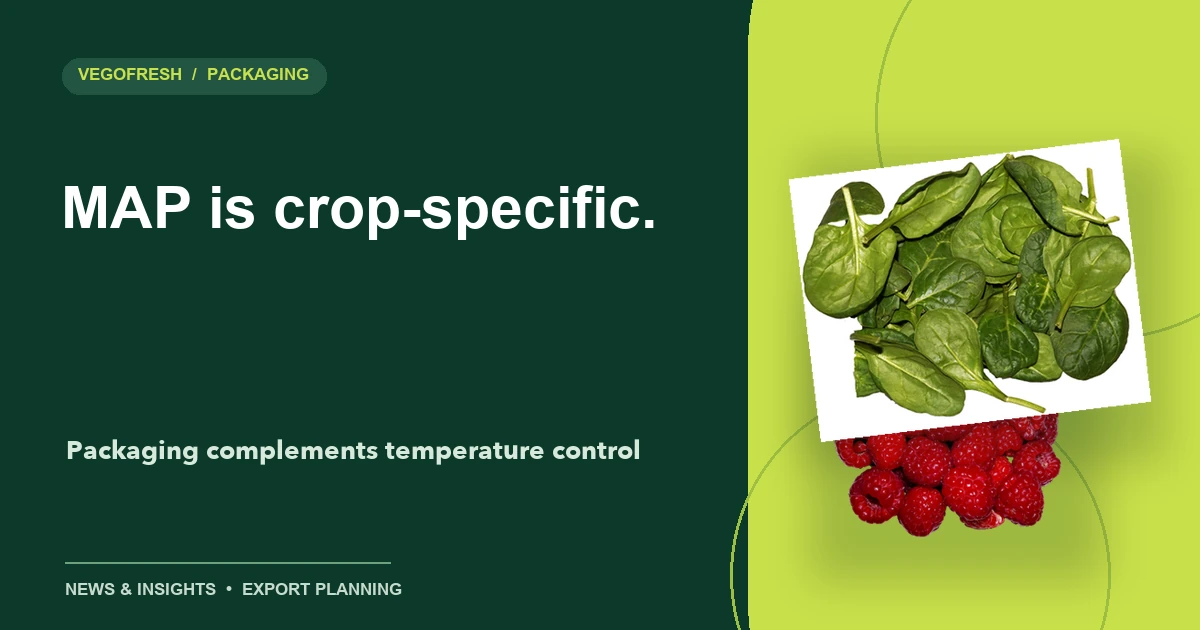
MAP is often described as a bag that makes produce last longer. That misses the first condition. The FAO postharvest handling manual states that controlled or modified atmospheres supplement proper temperature and relative-humidity management; they do not substitute for it. A warm product packed into a carefully specified film still carries field heat into the journey. The film may also behave differently when its temperature changes.
Industry discussion (anecdotal): A packaging supplier explains changes to the gases inside a modified-atmosphere pack. Its marketing claims are not a controlled comparison. Ask for measured gas levels and quality at named temperatures, plus the film specification and cultivar, before approving an extended route. Source: Xiaohongshu note by 惠农智慧气调保鲜 (reviewed 10 October 2026).
What changes inside a produce pack?
Fresh produce continues to respire after harvest. A pack restricts exchange with outside air to a degree set by its material, vents and seal. The crop consumes oxygen and releases carbon dioxide; the surrounding gas composition changes until production and exchange approach a balance. For an importer, the relevant question is not the gas number printed in a proposal. It is what the product experiences across packing, inland handling, loading, transit, unloading and retail display.
Ask a packaging supplier to state the exact crop, cultivar, weight per pack, maturity, temperature range, film or vent specification, intended journey and measured gas levels at several points. “MAP compatible” is not enough. Results at one test temperature cannot simply be carried into a route with a different temperature history.
Why crop-specific guidance matters
| Crop | What an original source indicates | Question for the proposed pack |
|---|---|---|
| Whole romaine or loose-leaf lettuce | UC Davis warns that intact heads can be injured by excessive carbon dioxide; cut product has different needs. | Is this whole or fresh-cut product, and were injury symptoms checked? |
| Broccoli | UC Davis notes an off-odour risk at very low oxygen, especially with temperature variation. | How does the pack behave during a realistic warm excursion? |
| Strawberry | UC Davis describes benefits from elevated carbon dioxide during shipment under its conditions. | Were decay, flavour and saleable condition measured together? |
| Raspberry and blueberry | UC Davis describes reduced decay under some modified atmospheres but warns of off-flavours and browning if gases go too far. | Were the named berry and cultivar tested, rather than a generic “berry” pack? |
These source examples are risk boundaries, not settings to copy into a commercial packing line. They also show why results cannot be transferred between a whole lettuce head and fresh-cut leaves, or between raspberries and blueberries. A pack that reduces visible mould may still fail a flavour or texture test. Likewise, a good storage result can leave too little selling time after distribution.
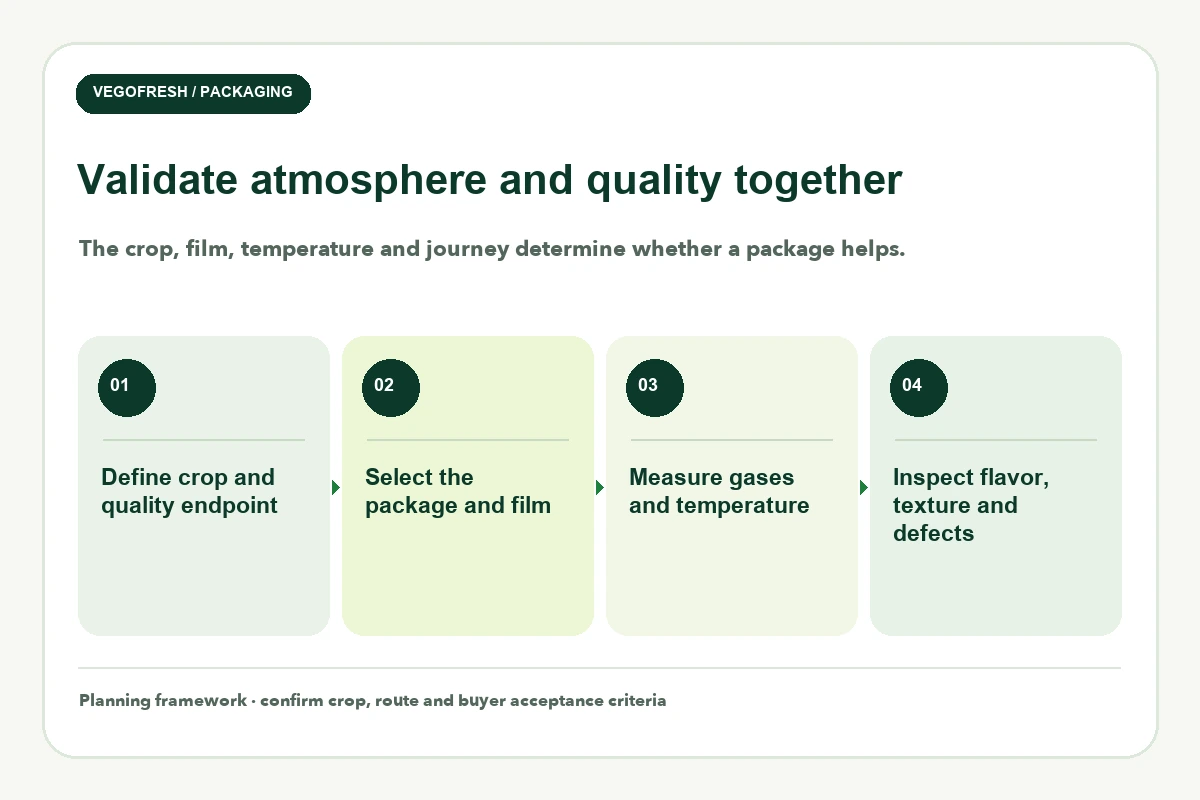
A simple validation plan for buyers
- Define the endpoint. Write down the arrival grade and the minimum selling window after arrival.
- Choose the actual crop. Name cultivar, maturity, cut status and pack weight; avoid extrapolating from another product.
- Pre-cool and document it. Record product temperature before sealing and at loading. Compare with an unpackaged or current-pack control when feasible.
- Measure the environment. Record pack gases, product temperature, humidity and condensation at planned checkpoints, including a realistic delay scenario.
- Inspect more than appearance. Check decay, texture, off-odour, flavour where relevant, and accepted weight; continue the test into the buyer’s normal display period.
- Repeat changed conditions. A different season, harvest stage, film supplier or route can alter the result.
For crops with known sensitivity, design the trial with a qualified postharvest specialist and confirm that any treatment, film or label is permitted in the destination market. MAP is a process decision involving the supply chain, not a substitute for food-safety controls or an import authorisation.
The linked FAO and UC Davis pages explain general postharvest behaviour. This article does not disclose a VegoFresh gas recipe or claim that a specific product will remain saleable for 30 days. Such a claim would require a defined crop, pack, recorded conditions and independently understandable quality result. See how we read shelf-life evidence.
Explore the relevant lettuce, broccoli and strawberry pages, then request a crop-and-route packaging assessment. Share the cultivar, current pack, intended destination and buyer’s acceptance criteria; those details make a preservation trial useful.
Turn the article into a test plan.
Tell us the crop, origin, destination and arrival standard. We can identify which records are relevant and what still needs validation.