



What a reefer temperature log should show a produce buyer
By VegoFresh Editorial Team · Published
A setpoint does not prove product temperature or saleability. This guide shows the trace, handoff and grading records to request.
Evidence and route conditions are named in the article. Results for one crop or setting should be checked against the buyer’s own arrival standard.
What should a reefer temperature log show? It should let a buyer reconstruct when and where the cargo was exposed to temperatures outside the agreed handling range. The container’s setpoint alone is not enough: it records an instruction to the equipment, while the product and air around it may have different temperature histories.
The FAO’s fresh-produce transport guidance calls for monitoring product temperature during transport and checking it at transfer and arrival. That distinction matters because a logger in a container measures the air at its location. It cannot, by itself, prove the temperature inside every carton or the saleability of the crop.
Industry discussion (anecdotal): A trucking-software demonstration shows how a temperature report can be exported. A downloadable trace does not by itself establish produce temperature or uninterrupted control. Ask where each sensor was placed, when data capture began and how gaps or alarms were explained. Source: Xiaohongshu note by 车务慢语社 (reviewed 10 October 2026).
Five elements of a useful log
- A complete timeline. State the time zone and identify packing, loading, terminal entry, departure, arrival, unloading and buyer receipt. A graph with unlabelled hours is hard to compare with a bill of lading or a quality complaint.
- The measurement location. Identify whether each trace is return-air, supply-air, a carton logger or a product probe. Record device position within the load. Sensors at different positions answer different questions; none is automatically representative of every carton.
- Readable data and device information. Preserve the raw export, units, measurement interval, device identifier and any calibration or accuracy record available under the agreed protocol. A screenshot alone may hide missing periods or changed settings.
- A documented target. Include the agreed cargo temperature range, setpoint, ventilation or atmosphere settings where relevant, and who approved changes. A temperature spike needs context before it can be called a breach.
- Quality measurements. Note product temperature at loading and receipt, sample locations, visible defects, accepted weight and follow-up quality after delivery. The trace explains exposure; inspection tests the commercial result.
For a trial, agree on sensor locations and sampling before shipping. If the route changes between warehouse, truck, terminal and container, decide which party is responsible for each recording period. The goal is a continuous chain of evidence, not an impressive-looking graph that starts after the crop was already warm.
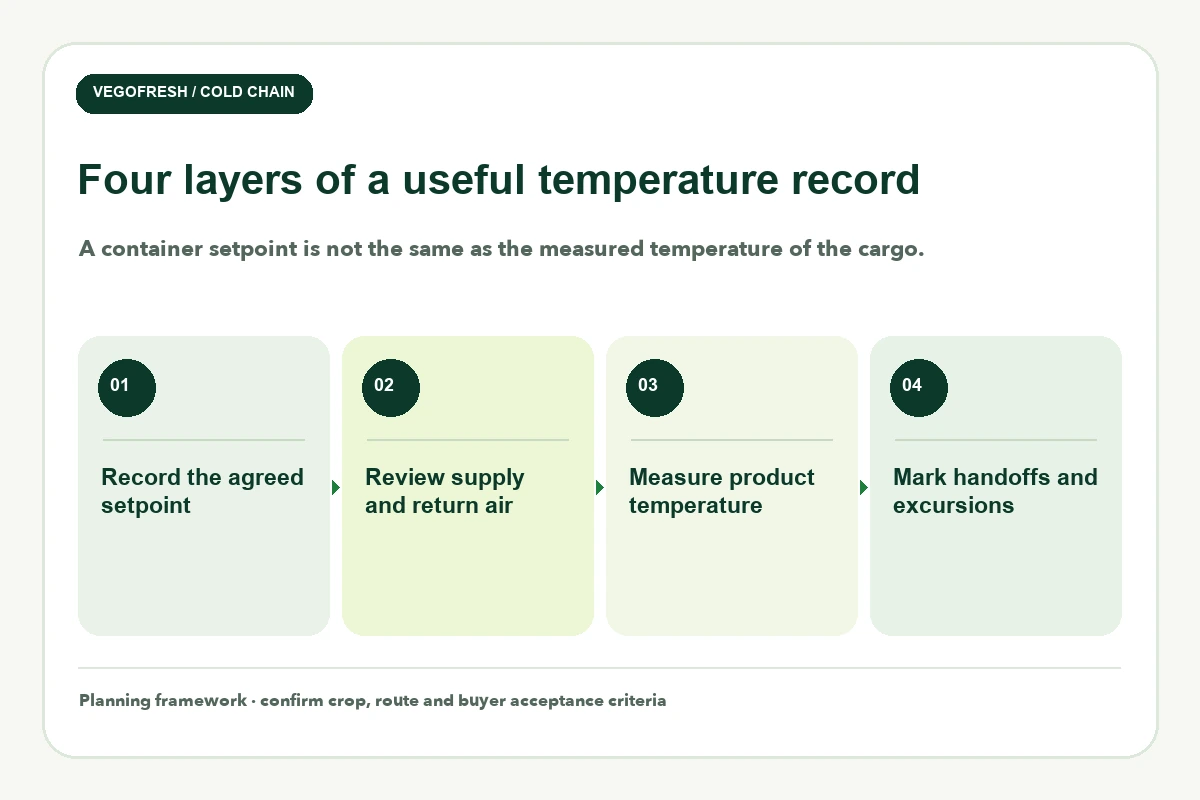
Setpoint, air temperature and product temperature are different
A reefer’s setpoint is its operating target. Supply or return-air readings reflect conditions at sensors in the equipment. A probe or documented spot check samples the crop itself. The Hapag-Lloyd pre-cooling notice explains that a reefer is mainly designed to maintain cargo that reached its transport temperature before loading. A setpoint near the target cannot establish that warm produce was already cooled when doors closed.
Record both product and ambient conditions at handoffs. If a later quality problem is found, the buyer can then ask whether the issue began before loading, during a transfer, in the container, or after unloading. Even a continuous in-range trace cannot prove freedom from bruising, decay or maturity-related loss; those require inspection.
How should buyers read an apparent excursion?
| Question | Evidence to examine |
|---|---|
| Was the cargo warm before loading? | Pre-cooling completion record and product-temperature samples at loading |
| Which sensor moved? | Device identity, position and raw trace from nearby sensors |
| What happened at that time? | Door, power, transfer, handling or equipment event records |
| Did quality change? | Arrival grade, defect photos under a shared protocol, accepted weight and post-arrival hold |
Do not diagnose a trace from one isolated high reading. Confirm the sensor and time stamp, compare the event log, and inspect representative cartons. Likewise, do not dismiss a repeated or unexplained exposure because the container later returned to target. The investigation should follow the actual product and the contractual grade.
Keep a common evidence package for both routine shipments and exceptions. Export the original logger file soon after delivery, label it with the shipment and lot identifiers, and retain the version used for the buyer review. Attach a short event timeline and inspection form. If the parties later disagree, this package makes it possible to distinguish a missing recording period from a measured temperature change. It also helps the supplier improve the next trial instead of arguing from a single photograph.
What should appear in the shipment brief?
Name the crop and cultivar, pack, target product temperature at loading, approved container settings, sensor plan, handoff responsibilities, raw-data delivery format and arrival inspection method. For spinach, strawberries or roses, those details will differ. Read how VegoFresh frames its preservation work or request a monitored route trial with the records your procurement team needs.
Turn the article into a test plan.
Tell us the crop, origin, destination and arrival standard. We can identify which records are relevant and what still needs validation.