


Berries by air or sea? When the faster route still wins
By VegoFresh Editorial Team · Published
Raspberries and blueberries need separate route decisions. The cheapest freight quote may not produce the lowest cost per saleable kilo.
Evidence and route conditions are named in the article. Results for one crop or setting should be checked against the buyer’s own arrival standard.
Short answer: Air freight can still be the right choice for delicate berries when the proposed sea route has not demonstrated enough accepted fruit and selling time at destination. Compare routes by landed cost per saleable kilogram, not freight price per shipped kilogram. Raspberries and blueberries need separate calculations and trials.
There is a biological reason to avoid a single “berry” rule. In its conventional postharvest guidance, UC Davis lists raspberry and blackberry at roughly two to five days under optimum conditions, while blueberry is listed at roughly one to two weeks. The same sheet says berries should be harvested near ripe because eating quality does not improve after harvest. These are general storage estimates, not maximum limits for any proprietary process and not evidence that any particular VegoFresh berry shipment has arrived after a longer voyage. Read the UC Davis bushberry fact sheet.
Industry discussion (anecdotal): A raspberry grower describes crushing and leakage during domestic parcel delivery when the pack was unsuitable. This is not sea-export evidence. It does identify mechanical damage categories to measure in a raspberry arrival grade, alongside decay and accepted weight. Source: Xiaohongshu note by 潇月 (reviewed 10 October 2026).
What air freight actually buys
Air transport mainly buys a shorter planned journey. It does not erase handling risk: fruit can still wait at a farm, airport, transfer point or destination warehouse. IATA’s perishables guidance treats packaging, storage, environmental conditions and coordination across handlers as parts of the air-cargo chain. For a high-value raspberry order with little spare quality life, a short journey may be worth the additional freight expense. That is a route decision, not a statement that air will always deliver better fruit.
Ocean freight can become attractive when the crop, packaging and cold-chain process maintain buyer-acceptable quality through the actual route, including port dwell and onward delivery. A promising storage test is a reason to test that route. It cannot replace arrival grading. Our guide to shelf-life evidence explains the difference.
Use one cost equation for both routes
For each route, total the crop cost, packing and treatment, inland handling, international freight, insurance, clearance, destination handling and any documented disposal or claim cost. Then divide by kilograms that meet the agreed grade at the buyer’s receiving point:
Landed cost per accepted kilogram = all route costs ÷ kilograms accepted at arrival.
This simple equation needs one more commercial check: how many days can the buyer still sell those accepted kilograms? A route may have a low landed cost at the port and still fail if the accepted fruit cannot pass through distribution before quality falls below the agreed grade. Use the buyer’s actual channel, not a laboratory day count, for that second test.
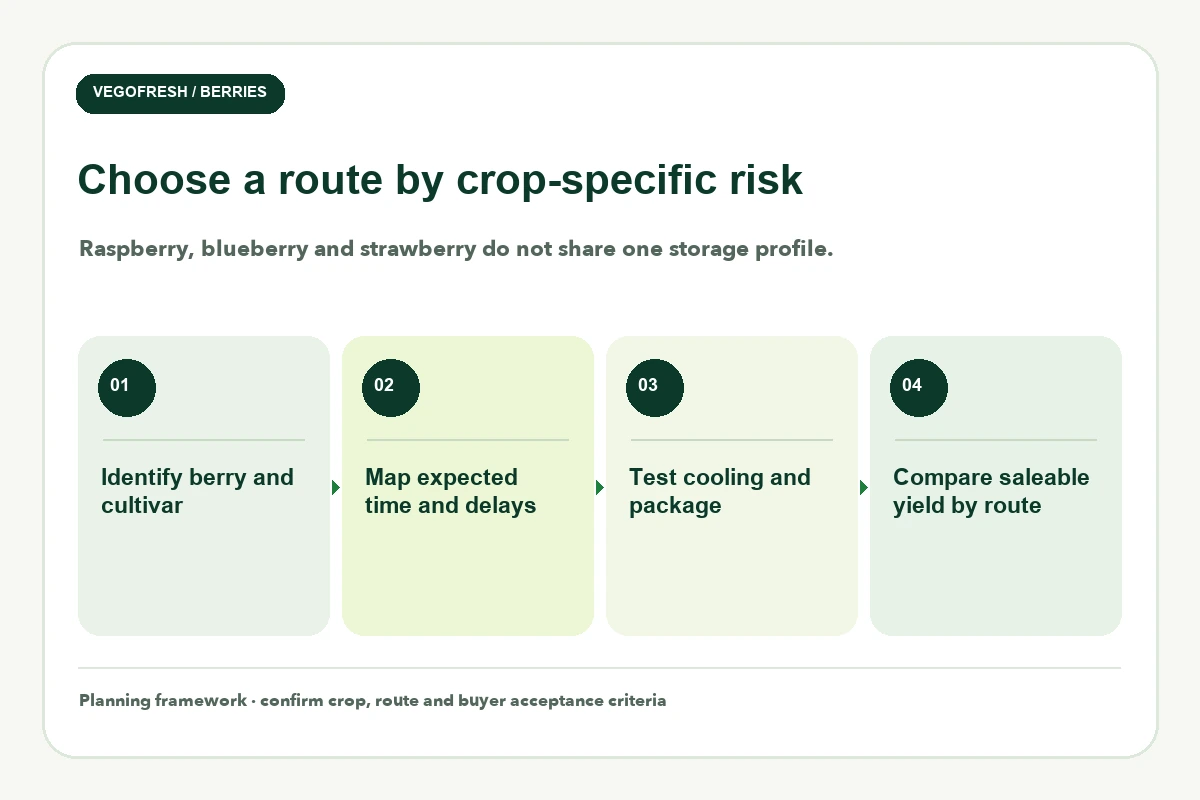
Compare raspberries and blueberries as different products
| Buyer question | Raspberry trial | Blueberry trial |
|---|---|---|
| Harvest and condition | Define maturity, firmness, dry pick and leakage threshold | Define maturity, bloom appearance, firmness and shrivelling threshold |
| Pack | Check crushing, airflow, condensation and visible mould | Check ventilation, moisture loss and fruit-to-fruit variation |
| Route decision | Demand arrival and short post-arrival hold data before replacing air | Assess the named variety and route independently; do not assume every blueberry behaves alike |
UC Davis notes that modified-atmosphere shipment can reduce decay and softening in some berries, but it also warns that excessively low oxygen or high carbon dioxide can cause off-flavours or brown discoloration depending on cultivar, time and temperature. The presence of a film or atmosphere label therefore cannot itself validate a long route. Read our crop-specific modified-atmosphere guide for the questions to ask a pack supplier.
When to keep the air route
Keep or test air first when the selling programme is date-critical; when fruit is already close to its quality threshold; when the ocean itinerary has long or uncertain transfer time; when destination handling cannot protect the cold chain; or when a sea trial has not shown enough accepted fruit after arrival. A route may also need to remain on air for one cultivar or season while another berry moves by sea. Treat that as a rational segmentation decision.
For a fair comparison, run a small, measured trial with the same origin lot and comparable grading rules. Record product temperature at packing and loading, a time-temperature log, arrival defects, accepted weight and a defined post-arrival hold. A refrigerated container chiefly maintains pre-cooled cargo temperature; it should not be asked to remove large amounts of field heat after loading, as Hapag-Lloyd’s pre-cooling guidance explains.
UC Davis figures are conventional commodity guidance. This article does not claim a verified 30-day raspberry or blueberry sea arrival, or a fixed freight saving for VegoFresh. Any such claim requires the named berry, route conditions and buyer acceptance record.
Explore the crop pages for raspberries and blueberries, or request a comparison for your origin and destination. Share the variety, weekly volume, current air terms, proposed sea itinerary and minimum selling window so the assessment answers a real buying question.
Turn the article into a test plan.
Tell us the crop, origin, destination and arrival standard. We can identify which records are relevant and what still needs validation.