


Why pre-cooling matters before fresh-produce export
By VegoFresh Editorial Team · Published
A reefer mainly maintains cargo that is already cold. Document crop temperature and each cooling handoff before loading a long route.
Evidence and route conditions are named in the article. Results for one crop or setting should be checked against the buyer’s own arrival standard.
Why pre-cool fresh produce before export? The container or aircraft is a transport environment, not a substitute for removing field heat at the packhouse. A buyer should know the crop’s temperature before loading, how it reached the agreed range, and whether that temperature can be maintained through each transfer.
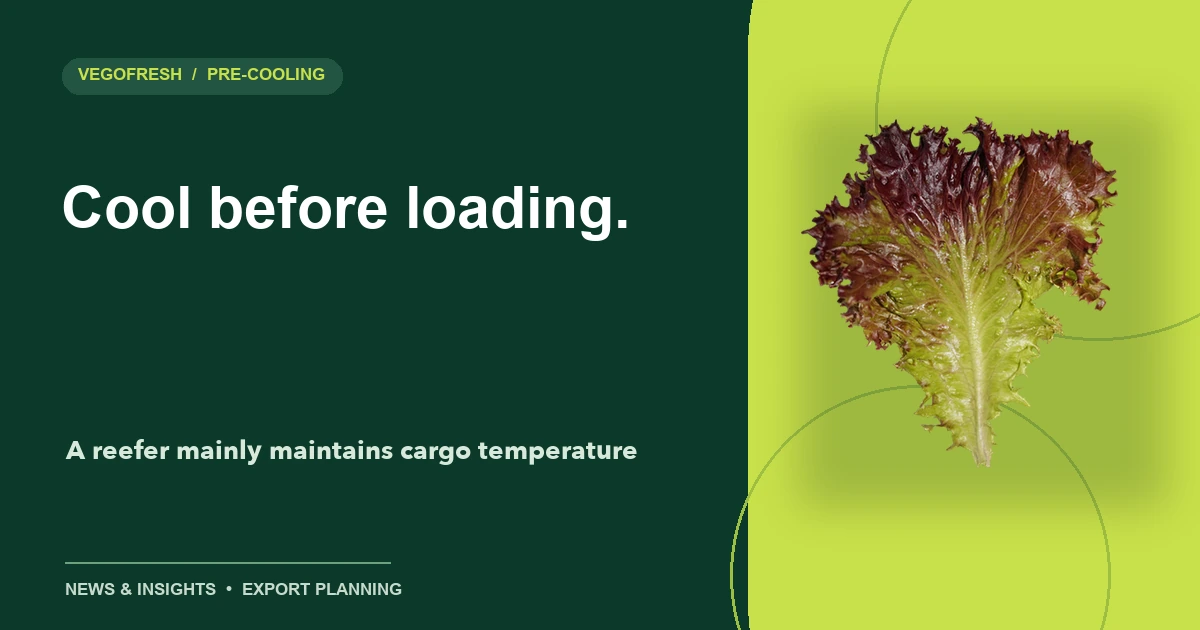
The FAO’s cold-chain guidance treats harvest timing, shade, rapid movement into suitable storage and refrigerated distribution as connected steps. Hapag-Lloyd’s carrier notice is equally direct: a reefer container is mainly intended to maintain the temperature of cargo that has already been cooled, rather than bring a warm load down to transport temperature.
Industry discussion (anecdotal): A farm-side note emphasizes prompt pre-cooling after vegetable harvest. It provides no controlled, crop-specific export result. Treat it as an operational question: who owns the harvest-to-cooling interval, and where are the actual time and temperature records? Source: Xiaohongshu note by 顾南憨憨 (reviewed 10 October 2026).
What should happen between picking and loading?
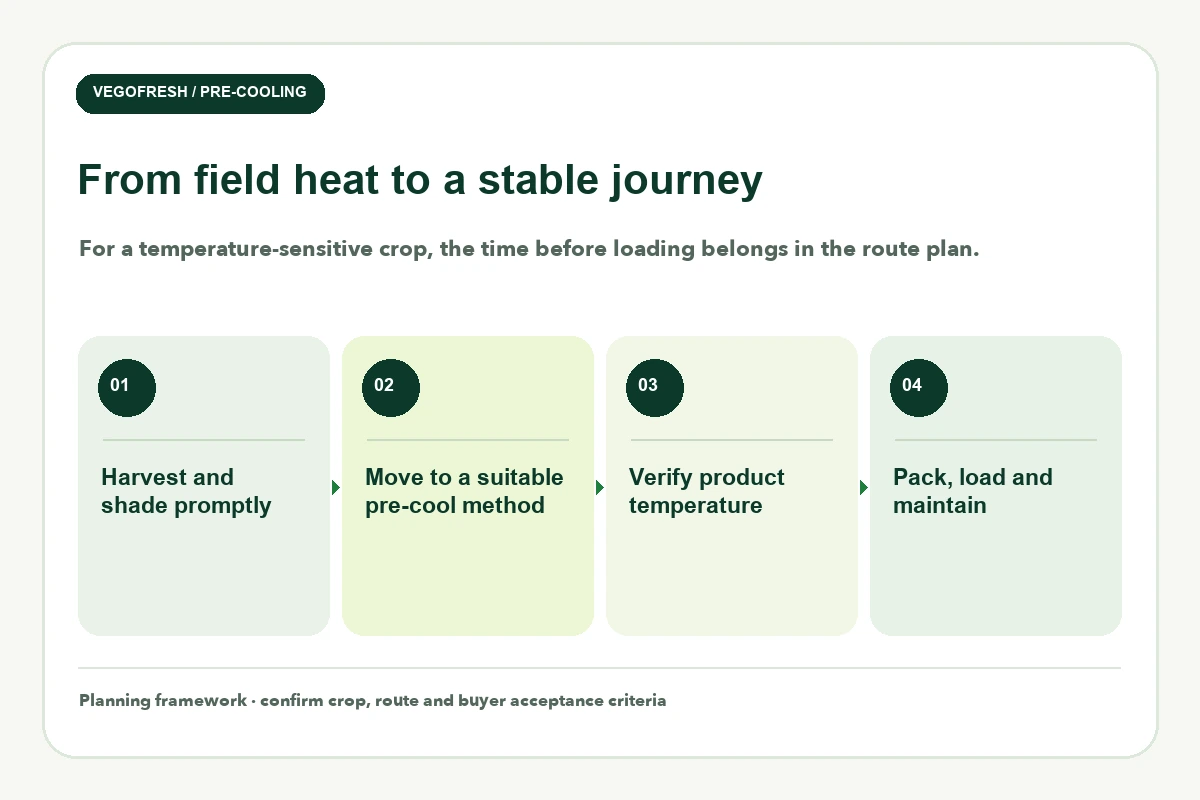
Begin with a harvest plan that identifies the cultivar, maturity and harvest window. Keep field containers out of direct heat where the process allows, move them promptly to the packhouse, and document when cooling begins. Then select a method suited to the commodity and pack. Cooling methods are not interchangeable: the method must work with the crop’s sensitivity, the package design and the hygiene controls at the facility. The FAO’s postharvest-handling guidance lists pre-cooling and refrigerated transport as parts of the same chain.
For strawberries, this timing is particularly important. The UC Davis strawberry factsheet recommends rapid cooling after harvest and gives crop-specific temperature and humidity guidance. That source describes conventional strawberry handling. It does not prove that pre-cooling alone will allow a particular strawberry lot to survive a long sea route.
Agree on a cooling exit rule before the first lot is processed. It should say which product locations will be measured, how many samples will be taken, what range will be accepted, and who can release the lot for loading. A single surface reading near a cold-room door may not represent fruit deeper in a carton or pallet. If readings disagree, record the variation and investigate the process before treating the lot as ready. This is a suggested buyer control, not a prescribed temperature for all crops.
A pre-cooling handoff record buyers can use
| Record | Why it matters |
|---|---|
| Harvest lot and time | Links the cooling trace and later inspection to the exact crop |
| Cooling start and end | Shows how much uncooled time preceded shipment |
| Method and package | Shows whether the selected process matches the pack being shipped |
| Sampled product temperature | Checks cargo condition before it enters the transport equipment |
| Transfer conditions | Identifies gaps between packhouse, truck, terminal and container |
| Exception and corrective action | Explains any delayed cooling or out-of-range measurement |
Why can a cold container still deliver poor-quality produce?
The cargo may have entered warm, arrived with mixed maturity, spent time outside the cold chain during loading, or been packed so that cooling and airflow were uneven. Handling damage and decay can also appear despite a suitable container air trace. A quality investigation must therefore pair the transport log with product-temperature samples and grading at both ends. Our temperature-log guide explains how to read those records without treating setpoint as product condition.
There is also no single ideal cooling target for “fresh produce.” The UC Davis spinach and strawberry references describe different handling details; flowers need their own protocol. The goal is to put the selected crop into its validated condition, document that it got there and keep the chain intact. Packaging or modified atmosphere cannot compensate for an avoidable temperature gap; FAO explicitly describes atmosphere control as an addition to temperature and humidity management.
For trial comparisons, keep the measurement method consistent between lots. A change in harvest timing, carton design or cooling capacity can make two shipments look similar in a container log while starting in different conditions. Recording these upstream factors gives the importer a better basis for interpreting differences in arrival grade. It also shows which operational change can be tested next if a route misses the buyer’s standard.
What should a buyer request before a trial?
Ask for a lot-level process map, product-temperature target, documented cooling method, sampling plan, logger locations, contingency for delayed loading and an arrival quality standard. For leafy greens or strawberries, compare the actual route against a controlled trial rather than assuming a generic process. See the VegoFresh route-assessment framework or share your crop and route to scope the temperature records a buyer can verify.
Turn the article into a test plan.
Tell us the crop, origin, destination and arrival standard. We can identify which records are relevant and what still needs validation.