


Exporting fresh produce to Saudi Arabia: a shipment checklist
By VegoFresh Editorial Team · Published
A Saudi importer should confirm the exact product's access, registration and clearance steps before the exporter packs the shipment.
Evidence and route conditions are named in the article. Results for one crop or setting should be checked against the buyer’s own arrival standard.
Short answer: A fresh-produce shipment to Saudi Arabia should be planned with the Saudi importer before packing begins. Confirm the exact commodity’s eligibility and current rules, register the importer and items where required, prepare matching commercial and phytosanitary documents, and agree who will file the clearance request. A cold-chain plan matters, but it does not replace market access or paperwork.
This is a planning guide for fresh vegetables and fruit intended as food, not a legal approval for a particular shipment. It uses the Saudi Food and Drug Authority’s Conditions and Requirements for Food Clearance, checked on 10 October 2026, and the international IPPC standard for phytosanitary certificates. Rules, commodity lists and circulars can change. Cut flowers and other non-food plants need their own route check rather than this food-clearance checklist.
Industry discussion (anecdotal): A Gulf-market discussion raises importer, port and distribution-channel questions. Its market-size and customs claims are not a source for Saudi requirements. Confirm exact commodity access, documents and channel with the importer and current official guidance. Source: Xiaohongshu note by INTO中东 (reviewed 10 October 2026).
Check market access before placing the order
“Saudi Arabia imports vegetables” is too broad to authorize a shipment. The buyer and exporter need the exact botanical product, intended use, origin, production or packing establishment where relevant, and entry port. Ask the Saudi importer to check current SFDA technical regulations and circulars and any separate agricultural or plant-health conditions that apply to that crop and origin. A phytosanitary certificate indicates that a consignment meets stated plant-health requirements; it is not a blanket import permit or a promise of customs release.
Where a buyer requests an organic, quality or other mark, treat that as a separate evidence question. The SFDA guide states that certain claims and logos on food labels require supporting proof. If the purchase specification uses a claim, agree on the exact certificate and label before printing cartons.
Divide the work between importer and exporter
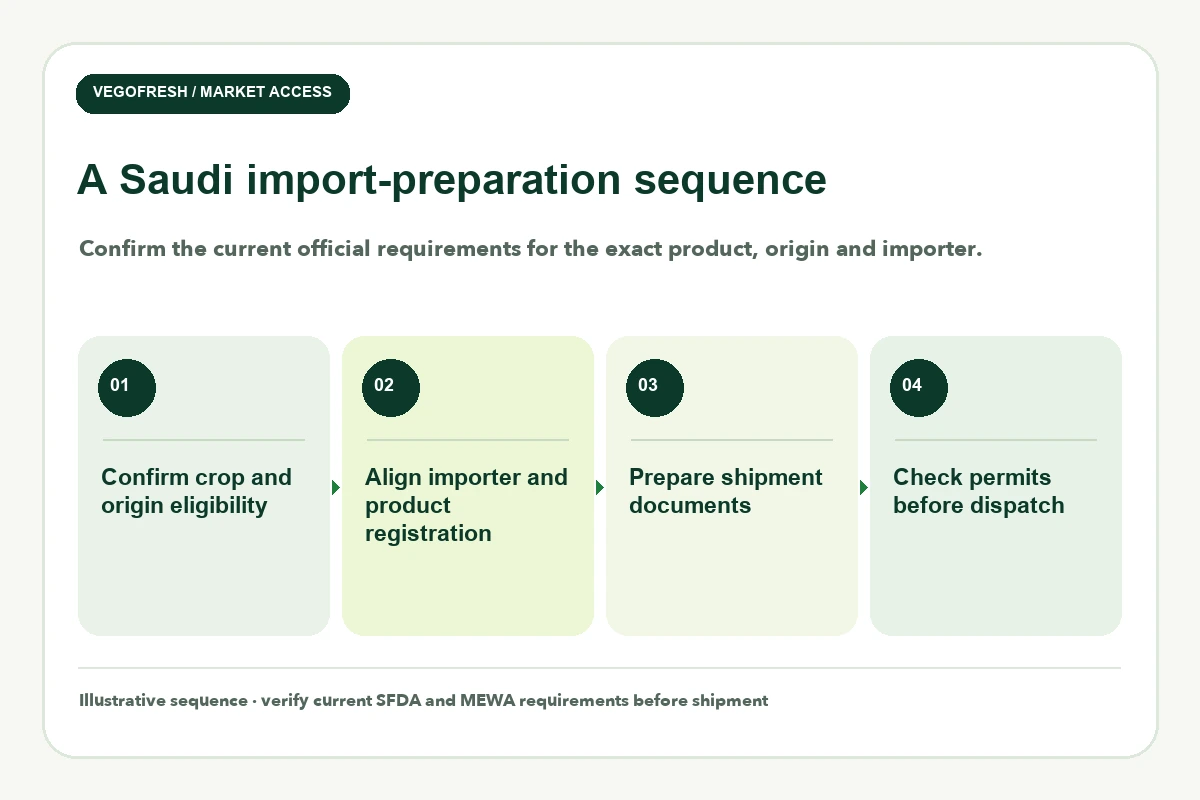
The SFDA guide states that, before importing commercial food, the importer must register its establishment and intended food items on the Ghad platform, follow applicable technical regulations and circulars, and submit clearance requests through Fasah. It also discusses warehouse requirements with stated exceptions. These are importer-side steps; a Chinese grower cannot solve them by adding a document to the box at the last minute.
| Workstream | Exporter should prepare | Saudi importer should confirm |
|---|---|---|
| Product and route | Exact crop, variety, origin, packing site, intended quantity and port plan | Current eligibility, item registration, applicable circulars and entry conditions |
| Commercial records | Consistent invoice details, origin document and transport information | Required format, buyer details and Fasah filing party |
| Plant health | Arrange official phytosanitary inspection and certificate for the named consignment | Any additional commodity- or origin-specific declaration |
| Cold chain | Product condition, pre-cooling, pack and handover-temperature records | Receiving schedule, inspection protocol and destination distribution conditions |
The guide’s general clearance list includes copies of a certificate of origin, commercial invoice and bill of lading. Its notes expressly call for a phytosanitary certificate copy for fresh vegetables and fruits. The invoice requirements and other certificates depend on the product. These points come from the SFDA guide, pages 7–8 of the PDF; the importer’s customs agent should reconcile the current checklist against the actual shipment before dispatch.
Make the paperwork describe the same physical cargo
A practical document review checks that the seller, buyer, product description, batch or lot, quantity, origin and transport identifiers can be reconciled across the invoice, packing list, phytosanitary record, origin certificate and bill of lading. The SFDA guide expressly lists several of these documents; the packing-list cross-check is a VegoFresh operational recommendation, not an additional claim about a Saudi mandatory form. Confirm any required Arabic labelling or other technical specification with the importer and current SFDA rules.
Keep a route sheet with pre-cooling completion, loading time, product temperature, seal and logger identifiers, estimated arrival, and named contact at every transfer. This is especially useful for leafy vegetables and soft fruit, where commercial quality can change quickly during a delay. Those records support an arrival-quality discussion; they do not establish regulatory compliance by themselves.
Five questions to close before booking freight
- Is this precise product from this origin permitted under the current Saudi requirements?
- Has the importer registered the establishment and food item where required?
- Who issues the official plant-health certificate, and are extra declarations needed?
- Do invoice, origin, shipment and labelling details match the receiving party’s clearance instructions?
- What is the arrival inspection standard and contingency plan if customs or delivery is delayed?
This guide is based on a Saudi authority document available on 10 October 2026. It is an editorial checklist, not a determination of commodity access, permission to import, or a guarantee of clearance. The importer and its licensed advisers must check the current official requirements for the exact consignment.
For the quality side of the plan, see our crop-specific export solutions and arrival inspection checklist. If you are assessing a Saudi programme, send VegoFresh the crop, origin, port and buyer specification so the proposed preservation and trial plan can be scoped against a real route.
Turn the article into a test plan.
Tell us the crop, origin, destination and arrival standard. We can identify which records are relevant and what still needs validation.