


Tonghai broccoli by sea: what a 2023 company record shows
By VegoFresh Editorial Team · Published
A historical company presentation reports a November 2023 sea dispatch of Tonghai broccoli to the Middle East. The supplied page does not quantify its arrival quality.
Evidence and route conditions are named in the article. Results for one crop or setting should be checked against the buyer’s own arrival standard.
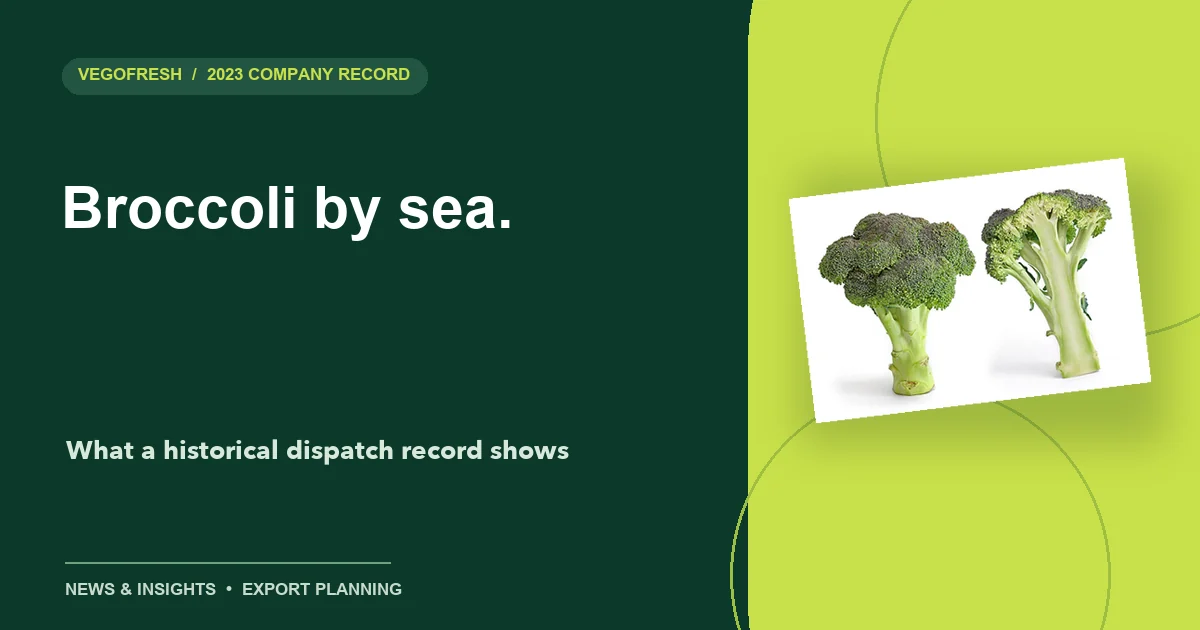
Broccoli can be a demanding crop on a long route. A buyer needs heads that meet the agreed grade on arrival and enough selling time to move them through the local market. A promising storage figure is useful, but a shipment decision also depends on the exact crop, pack and journey.
A historical Synarise company presentation gives one concrete starting point. It says broccoli from Tonghai, Yunnan, was sent to the Middle East by sea in November 2023. The record identifies an origin, crop, destination region, transport mode and month. It does not include an arrival inspection for that lot. Read the Tonghai case summary.
Keep the dispatch and storage statements separate
The same presentation says a crop-specific preservation process kept vegetables tasting fresh and looking green after 45–60 days. That is a broader statement about vegetables. The page does not say that the November broccoli lot spent 45–60 days in storage or at sea.
This distinction matters when planning an order. The sea-dispatch account shows that the company reported sending Tonghai broccoli on a long-distance route. The broader preservation statement suggests a reason to investigate the process. Neither statement, on its own, gives the arrival grade, accepted weight or remaining selling window for the reported shipment.
The presentation also describes earlier reliance on foam boxes and ice packs or bottles and calls transport costly. It provides no measured freight comparison. A buyer should build the cost case from quotations and actual saleable yield for the proposed route, rather than attach a savings percentage to this example.
What would make this case useful for a new broccoli route?
For a shipment from a different harvest, packhouse or season, ask for the records that connect a dispatch to a saleable result:
- Product and pack specification. Record the broccoli variety or type, maturity, head size, trim, carton format and loading pattern.
- Condition history. Document time to cooling, temperatures during inland transport and port dwell, reefer settings and logged conditions through delivery.
- Arrival assessment. Agree on defect limits and inspect a defined sample for colour, firmness, decay and other buyer grade requirements.
- Selling window. Check the accepted broccoli again after a realistic period in the destination distribution chain.
- Commercial comparison. Compare landed cost per accepted, saleable kilogram across the routes under consideration.
These checks turn a historical dispatch into a trial design for a specific buyer. They also make it possible to separate packaging performance from delays or temperature excursions elsewhere on the journey. See how to read shelf-life claims and explore the route-assessment process.
The Tonghai record is relevant because it reports a specific broccoli sea dispatch, while leaving the shipment outcome unquantified in the supplied page. If you are considering broccoli for a longer route, share your origin, destination and arrival standard so the required evidence can be defined before a trial.
Turn the article into a test plan.
Tell us the crop, origin, destination and arrival standard. We can identify which records are relevant and what still needs validation.