



Strawberry export: the buyer’s checklist before a long route
By VegoFresh Editorial Team · Published
A buyer-ready strawberry plan needs a named lot, cooling record, pack test, arrival grade and post-arrival selling window. Here's what to request.
Evidence and route conditions are named in the article. Results for one crop or setting should be checked against the buyer’s own arrival standard.
What should an importer ask before sourcing strawberries for a long export route? Ask for a lot-specific plan covering harvest maturity, rapid cooling, package protection, temperature evidence, arrival grade and the selling time required after delivery. “Kept for a number of days” is a useful trial result only when the crop and test conditions are clear.

UC Davis’s strawberry postharvest factsheet recommends prompt cooling and crop-specific temperature and humidity management. It also discusses elevated carbon dioxide during transport as one possible way to reduce gray mold under stated conditions. None of that is a blanket packaging recipe or a guarantee that any cultivar will arrive saleable after an ocean voyage. A buyer should require evidence for the exact fruit, pack and route.
Industry discussion (anecdotal): A cold-chain vendor groups chilled fresh fruit, atmosphere-treated fruit and frozen fruit under “preservation.” Its time claims are not verified here. For a fresh-strawberry purchase, keep frozen-storage claims out of the arrival specification and grade saleable fresh fruit on receipt. Source: Xiaohongshu note by 准点冷链定制管家 (reviewed 10 October 2026).
1. Define the strawberry the customer actually wants
Name the cultivar, origin, harvest window, intended colour at picking, size range, firmness expectations and taste standard. “Export grade” means little until both parties agree how fruit will be sampled and which defects count as rejects. Because maturity affects both eating quality and tolerance of handling, set the harvest specification with the destination buyer instead of asking the grower to pick the least ripe fruit that can travel.
2. Demand a harvest-to-cooling timeline
Ask when the lot was picked, when pre-cooling started, how product temperature was measured, and what it was at packout and loading. A container setpoint does not show that warm fruit had already cooled. Hapag-Lloyd’s reefer guidance says containers chiefly maintain cargo temperature after pre-cooling. Our pre-cooling guide offers a handoff record to request.
3. Make the pack a test variable
Specify punnet, liner, outer carton, ventilation and pallet arrangement in the trial record. Check that the pack protects fruit from compression and allows the intended cooling and handling process. If an atmosphere treatment is proposed, document the gas target and how it was validated for this cultivar. The UC Davis factsheet describes possible benefits of elevated carbon dioxide against decay, but that does not establish the right setting for every pack or prove the result after a particular route.
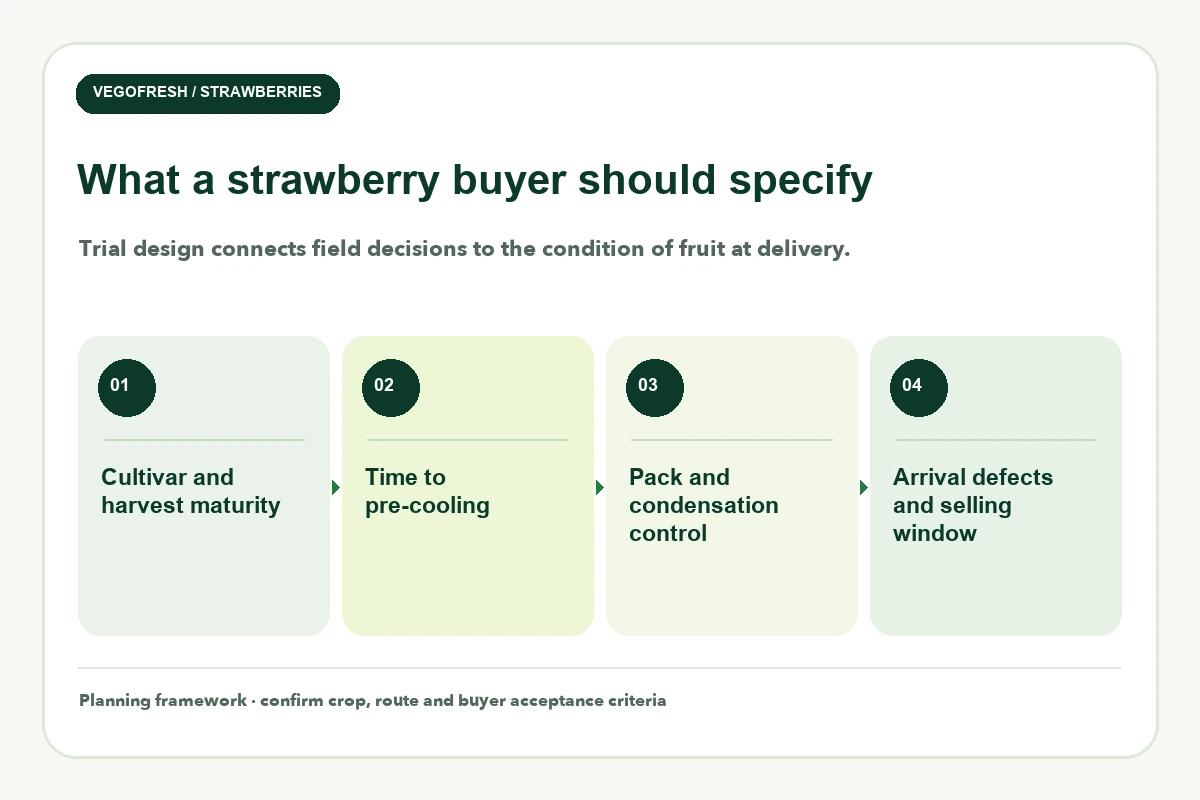
4. Agree what “good arrival” means
| Ask the supplier for | What the buyer should decide |
|---|---|
| Lot identity and sample plan | Which cartons and fruit are inspected, by whom and at what handoff? |
| Defect definitions | How are decay, bruising, leakage, softness and colour variation scored? |
| Weight and grade report | What share of delivered fruit meets the agreed commercial grade? |
| Temperature records | Where were air and product temperatures measured throughout the route? |
| Post-arrival hold | How long does accepted fruit remain saleable through normal distribution? |
Use the same inspection method in storage screening, pilot shipment and commercial follow-up. Photographs can document condition, but a few selected images cannot replace sampling across a lot. Our reefer-log guide explains which measurements help interpret the grading result.
5. Read the available VegoFresh record precisely
A historical Synarise presentation describes a 15-day storage observation of tree-ripe Yunnan strawberries that remained sweet and brightly coloured in the company’s account. The supplied material labels it an experimental case. It does not give a complete international shipment record, independent arrival grade, full temperature trace or post-arrival retail hold. It can help set the next trial’s questions; it cannot be turned into a “30-day sea freight” promise.
6. Compare routes using saleable fruit
Air may remain the right choice for a crop or sales window even if an ocean rate is lower. Compare full landed cost per accepted kilogram and check the remaining selling window separately. The IATA perishable-cargo guidance also makes clear that air quality depends on handling and delay management, so do not treat air as risk-free. Use a controlled pilot to measure both route outcomes under the buyer’s grade. See our comparison framework.
For a strawberry sourcing brief, share cultivar, pack, market, proposed delivery window and acceptance criteria. Explore VegoFresh’s route-assessment process or request a strawberry trial scope based on the evidence your buyers will actually use.
Turn the article into a test plan.
Tell us the crop, origin, destination and arrival standard. We can identify which records are relevant and what still needs validation.